Our Cruising Stories
Browse stories from both Ronna and Mike. Use the columns below to jump straight to each article.
Ronna's Stories
Reflections from life aboard, passages, landfalls, and the emotional side of cruising.
Mike's Stories
Mike's "From The Helm" Salty Dawg newsletter articles, newest first.
Mike's Stories
From The Helm - Mike's article for the Salty Dawg Newsletter: To Each Their Own
August, 2026
After the inevitable and predictable questions about pirates and hurricanes, the next question non-cruisers ask us is usually some version of, “Wait, it's just the two of you living together on a boat 24 hours a day, seven days a week? How can your marriage possibly survive that?”
It's a fair question and generates a far more interesting response than explaining that there really aren't very many pirates out there plundering cruising sailboats or how we do our very best to avoid sailing into hurricanes. For the past nine years, Ronna and I have lived, traveled, eaten, slept, worked, relaxed, entertained, argued and made up, all within the confines of a monohull. Actually, put that way, I'm beginning to understand the wonder. What I find interesting is how differently cruising couples make it work. No two appear to operate quite the same way.
On some boats, there is an obvious captain. On others, it can take several days before you figure out who is really in charge. Sometimes I'm not sure they even know. Some couples divide responsibilities along fairly traditional lines. Others completely reverse them. We know boats where the woman is clearly the more experienced sailor and the man is the mate, and wives who know their way around a diesel far better than their mechanically challenged husbands. We also know couples who are completely interchangeable; either can dock, navigate, reef, anchor, troubleshoot and handle the boat alone. From a safety standpoint, that may be the ideal arrangement. We even know a boat named Two Captains.
At the other end of the spectrum are couples where one partner doesn't make offshore passages at all. Usually, although certainly not always, it is the female partner who flies ahead while her significant other recruits friends or finds passage crew to move the boat. We know couples who have happily cruised that way for many years. We also know people whose spouses went home after a passage and never returned.
There are retired couples, younger couples working from their boats to sustain the lifestyle, second marriages, widowed or divorced partners who have chosen to cruise together without marrying, and just about every other variation imaginable. There are also many solo sailors, male and female, whom I very much respect, but they are a whole other topic.
I've observed that there isn't one successful model and that most cruising couples didn't design the way they operate. They evolved into it. Ronna and I certainly did. Our particular operating system is probably on the more conventional side. I usually handle the helm while docking and make most of the immediate sailing and seamanship decisions. But whenever we anchor or pick up a mooring, Ronna drives while I work on the bow. I'm also the Chief Engineer, a position for which I have recently acquired an unusually knowledgeable AI assistant named Scotty. (See May 2026.)
Where and when we go is always a joint decision. Ronna handles provisioning decisions and planning while I serve primarily as the schlepper. We consult on mechanical repairs, weather windows and routing, and Ronna does most of the advanced scheduling, including all the marina and mooring arrangements. She's also far more sociable and often takes the lead when making new friends.
Ronna also describes herself as Exodus's Chief Morale Officer and Admiral. In my hours of greatest frustration, when the repair list is too long to face or during a difficult passage, it's usually Ronna who lifts my spirits and keeps me going. Apparently consoling the Chief Engineer is also part of the Admiral's responsibilities.
Ronna generally defers to my sailing and seamanship experience. As a result, despite living together around the clock, we rarely have serious arguments aboard.
Then we get into a car.
Apparently, my decades of experience operating a cruising sailboat do not qualify me to change lanes without supervision. Ronna feels considerably more comfortable criticizing my driving than my docking, and the normal chain of command aboard Exodus ceases to apply at the rental-car counter.
That doesn't mean we always agree aboard. Sometimes I want to push Exodus harder than Ronna does. I may think conditions are perfect for adding sail and enjoying a spirited ride, but Ronna may look at exactly the same conditions and conclude that we are going quite fast enough, thank you. Years ago, I might have argued. I've learned better. I may be able to squeeze another knot out of the boat, but if Ronna is miserable for the next four hours, I haven't really improved the passage. And eventually, I'll pay for it.
Every cruising couple negotiates some version of this. One wants to leave today while the other wants to wait for better weather. One is ready to move on while the other wants another day in the anchorage. One sees an exhilarating sail while the other sees an excellent opportunity to reef. The same sailing conditions can look very different from opposite sides of the cockpit. Pushing too hard rarely ends well.
That may also explain why some couples cruise happily for years when only one of them makes offshore passages. They found a version of cruising that works for both of them. Cruising only works as a shared life if both people want to be living and enjoying it. There are plenty of opportunities for compromise aboard a sailboat. Wanting to be there in the first place isn't one of them.
Living aboard together doesn't mean doing everything together, agreeing about everything or even enjoying the same parts of cruising equally. Couples figure out what each person does well, where each is comfortable and when it is better to let the other person handle it.
There is also a level of dependence aboard that doesn't exist in quite the same way ashore. Offshore, when one of us goes below to sleep, we trust the other person with the boat and, quite literally, our lives. When something goes wrong, there's no one else right there to help. That creates a bond of complete trust. Couples develop that trust differently. For some, it comes from being able to perform every job interchangeably. For others, it comes from knowing that your partner is very good at the jobs they have assumed and will be there when you need them.
Ronna and I have also concluded that a sense of humor may be one of the most important ingredients in a lasting cruising relationship. Things break. Plans change. Weather deteriorates. Somebody makes a mistake (which somebody else occasionally points out at precisely the wrong moment). Knowing when not to point it out is another cruising skill I haven't completely mastered. Being able to laugh, particularly at yourself, has prevented more than a few minor irritations from becoming major fights.
There is another misconception hidden in that original question. Yes, we live together on a boat, but our life isn't just what happens aboard. The ocean is our backyard. So are the islands, towns, harbors and countries we visit. We swim. We hike. We explore new places all the time.
Another element that keeps cruising fresh is the constantly changing community of people we meet along the way. Cruising friendships can become remarkably close, remarkably quickly. Ronna frequently develops strong friendships with other cruising women and is very good at maintaining relationships with friends back home. We each have our own friendships and interests, and the cruising community provides a social world well beyond the two people aboard.
Finding another cruising couple where all four people genuinely enjoy one another is extra special. When it happens, you usually know it quickly. One sundowner becomes dinner, dinner becomes another anchorage together, and before long someone is adjusting an itinerary so the boats can meet again farther down the coast. There are also boats we are perfectly happy to wave goodbye to. In fairness, I'm sure other couples have had exactly the same feeling about us. Probably about me. Everyone seems to like Ronna.
After years of watching cruising couples, I'm not sure I'm any closer to answering the original question. We all inhabit the same unusual world, but we create remarkably different lives within it. One captain or two. Specialized roles or complete interchangeability. Married or unmarried. Passage partners or partners who meet again at the destination. Ronna and I evolved our own way of doing it, just as every long-term cruising couple seems to find theirs.
I still don't know how to tell anyone else how two people should live together on a sailboat.
Fortunately, I don't think there is one answer.
To each their own.
From The Helm - Mike's article for the Salty Dawg Newsletter: Worth the Wait
July, 2026
Why am I a sailor and not a powerboater? It's a question I occasionally ask myself because, as a Type A, largely impatient former attorney, sailing seems like an odd life choice. Someone with my temperament probably should have bought an Azimut.
Patience has never been one of my defining characteristics. A former business associate once described me as the least patient person he knew. I like to identify, analyze, and solve problems quickly. If something isn't working, I want to fix it immediately. If there's an obstacle, I want to find a way around it without delay. I want to be in control of my environment.
Yet, of all the ways to travel from one place to another, I deliberately chose one of the slowest on earth. Sailing depends on weather, tides, currents, replacement parts, marina availability, and whether the wind decides to cooperate, none of which I can control and all require waiting.
Come to think of it, a surprising amount of cruising consists of waiting. We wait for weather windows, tides to change, and the wind to fill in. We wait for bridge openings, marina slips, mechanics, ferry schedules, and room at a dinghy dock that is already three boats deep.
We wait at the fuel dock while the boat ahead of us decides this is the perfect opportunity to wash the boat with free water. We wait in the customs line, then the immigration line, then back to customs because that's just how they do it. We wait at the local market while everyone ahead of us seems to know the cashier by name and feels obligated to chat before paying.
We wait for replacement parts that are always "expected tomorrow." Cruisers eventually discover that "tomorrow" is less a day of the week than a state of mind. Tomorrow eventually arrives. The part often doesn't.
As I write this, I'm on passage from the Azores to Ireland, sailing hundreds of miles north to go east because that is where the wind is. I'm waiting, not always patiently, to reach it.
Cruisers spend an extraordinary amount of time waiting for things they cannot control, and we still choose this life.
There are sailors I genuinely admire who can drift along happily at two knots. They trim the sails, settle into the cockpit with a cup of coffee, and simply accept whatever the day brings. I have no idea how they do it, but I truly admire them. I've concluded they possess a level of emotional maturity I may never achieve.
Every sailor has a speed below which patience begins to wear thin. Some reach immediately for the engine controls. Some stare hopefully at the horizon. I pretend to monitor the situation...then I start the engine.
Every cruiser has some version of this. Maybe yours isn't boat speed. Maybe it's checking PredictWind every hour even though you know perfectly well it won't change the forecast. Maybe it's walking down to the marina office one more time, hoping your replacement part has magically arrived. Maybe it's watching the customs line and convincing yourself it is finally moving. We all have our tells.
Crew provides another opportunity to practice patience. Every skipper has faced the same choice: take the line and cleat it yourself, or watch someone struggle for another thirty seconds while quietly reminding yourself that this is exactly how they learn. Thirty seconds can feel surprisingly long.
The longer I cruise, the more convinced I become that patience is an essential cruising skill, perhaps one of the most important.
I've never met a sailor who regretted waiting one more day for better weather. I've met plenty who regretted not waiting. That observation applies to far more than weather.
Waiting for the wind instead of immediately reaching for the engine sometimes rewards us with one of those magical afternoons that remind us why we bought sailboats in the first place. Waiting for daylight before entering an unfamiliar harbor often turns a potentially dangerous arrival into an easy one. Waiting for the current to change and the tide to turn can transform a difficult sail into an enjoyable one. Waiting long enough for a crew member to solve a problem often creates a sailor who won't need your help the next time.
Cruising teaches us that there are times when we wait because we have no choice, and times when we wait because it is the best choice.
Sometimes waiting is the decision.
Good seamanship often requires immediate action. We reef before the squall arrives. We respond instantly to a dragging anchor. We deal immediately with a leak or an unfamiliar noise coming from the engine compartment. But good seamanship also means recognizing when action will not improve the situation. Sometimes the smartest thing we can do is wait. Sailing rewards good judgment, not impatience.
For those of us who have spent our careers solving problems and making things happen, that can be a surprisingly difficult lesson. On land, impatience occasionally works. Another phone call, another meeting, another conversation, another push, and sometimes things move. The sea doesn't work that way. The weather doesn't negotiate, and the wind and tides don't care that we have dinner reservations.
Most sailors are never told that patience is a cruising skill. Why doesn't any sailing school teach Patience 101? We may need to add another webinar.
We learn to anchor, dock, reef, navigate, troubleshoot engines, read weather, splice line, and recover a person from the water. We attend seminars, buy cruising guides, and compare notes with anyone willing to share their experience. But no one ever says, "If you really want to become a good cruiser, learn how to wait."
They should.
That being said, cruising hasn't exactly made me a patient man. I still check the forecast too often. I still get frustrated waiting for weather windows. I still glance toward the engine controls when our speed drops. But cruising has made me a better judge of when my impatience is helping, and when it only raises my blood pressure.
Cruising isn't about controlling the environment. It's the art of working with an environment you can't control.
Maybe an Azimut would not have suited me after all. It would have gotten me there sooner. I'm just not sure it would have taught me one of the most important skills I've ever learned.
Some things really are worth the wait.
From The Helm - Mike's article for the Salty Dawg Newsletter: Passage Brain
June, 2026
Last month I wrote about preparing to leave for an offshore passage and the elusive condition known as "Ready Enough." This month, it seems only fitting to write about what happens after you arrive at your destination.
I should warn you at the outset that I am writing this while still suffering from the condition I am about to describe. So, if this article wanders, repeats itself, or ends abruptly with a sentence about laundry, please understand that I'm doing my best. I have reread it twice, which may or may not have helped. I have reread it twice, which may or may not have helped.
Ronna and I recently arrived in Horta, on the island of Faial, in the Azores, after a successful Salty Dawg Rally passage from Bermuda. Elsewhere in this newsletter is an article that covers the Rally, including the passage, the weather, the fleet, and the social events. What I want to talk about is the strange mental condition that takes over after landfall.
I call it "Passage Brain."
Passage Brain is a condition that develops after days of living on watch schedules, sleeping in fragments, listening to every sound the boat makes, checking weather, trimming sails, checking batteries, making meals, cleaning up meals, and wondering whether that new noise is a problem.
Then suddenly, there is land. Not land on a chart plotter, real land. You've arrived at your destination with dreams of restaurants, toilets that do not move, long hot showers ashore, and conversations with people who did not just spend the last several days exclusively discussing bowel movements, wind angles, squalls, battery voltage, or whether anyone has seen the good headlamp.
You arrive, tie up or anchor, and begin the long-awaited transition back to normal life. By which I mean you step ashore and discover that your world is still moving. What?
You are land sick, which usually first appears at exactly the wrong moment, while standing in customs and immigration, trying to look respectable, alert, and fully in command of your paperwork. Meanwhile, your body is quietly insisting that the room is rolling, and your brain is wondering why the customs officer will not stop swaying.
Clearing customs after an offshore passage is a necessary first stop, and I am always grateful to be welcomed into a new country. Still, there is something slightly cruel about requiring sailors to complete forms, answer questions, and locate documents at precisely the moment when they are sleep deprived and least capable of remembering where they put anything. After several days at sea, even simple questions can feel challenging.
Boat name? Fine.
Port of departure? Usually fine.
What day is it? No idea. Ronna, I need help!
Then comes the social reentry. During the passage, your world becomes very small. It is your crew, your boat, the ocean, and the endless cycle of watches, meals, weather, and sleep. Suddenly, after arrival, there are people everywhere. Other crews, rally participants, marina staff, officials, tourists, waiters, taxi drivers, and actual human beings wearing clothes they didn't sleep in.
Seeing people other than your own crew is wonderful and slightly overwhelming. You are happy to see them. You are thrilled everyone arrived safely. You want to hear their stories, but you also may not be entirely ready for complete sentences.
Of course, not everyone arrives in the same condition. Some boats tie up, shower, and within hours are booking island tours, renting cars, planning hikes, and discussing restaurants. These people can be annoying. I admire them. I respect them. I do not understand them.
When I arrive after an offshore passage, my immediate goals are more modest: clear in, secure the boat, take a shower, eat something from a plate that doesn't slide off the table, and sleep on an immobile mattress.
Many cruisers are also thinking about Schengen. For those with only 90 days in the Schengen area, the clock starts ticking as soon as they arrive, and suddenly every day feels precious. A sleep day can feel like a wasted day, which is unfortunate, because sleep after a passage is not a luxury. It is an essential repair item, right up there with chafe checks and oil changes.
Still, the pressure is real. You've crossed an ocean and arrived somewhere beautiful. You want to explore. You want to see the island. You want to walk the streets, eat local food, take photographs, and start experiencing the place you worked so hard to reach. Unfortunately, your boat and body have other ideas.
The boat also made the passage, and she would like attention. There is salt everywhere. There are lines to rinse, sails to inspect, lockers to reorganize, laundry to do, systems to check, and repairs that were postponed with the optimistic phrase, "We'll deal with it in Horta."
Well, now you are in Horta and that phrase has matured into an obligation.
So, the first few days after arrival become a strange tradeoff between wonder and responsibility. You want to explore. You need to clean. You want to celebrate. You need to find the source of that smell. You want to sleep. You need to clear customs, check the boat, and finally deal with the damp pile of clothes in the corner growing mold.
No one puts this part in the brochure.
There are no glossy photos of a tired sailor holding a customs form in one hand and a bag of laundry in the other while trying to remember whether the passports are in the nav station, the ditch bag, or in the safe place, so safe that no one will ever find them.
The odd thing is that this period also becomes part of the joy. The first shower feels miraculous. The head isn't tilting. The bed doesn't require bracing yourself, and it feels amazing. Fresh bread becomes a major emotional event. A walk on land, once your legs and inner ear agree on basic principles, feels like a privilege.
And then come the stories.
Slowly, as people sleep, shower, eat, and regain the ability to speak in something other than watch-report fragments, the fleet begins to decompress. Crews compare notes. Everyone had a different passage, even when crossing the same ocean at the same time. One boat had more wind. Another had less. Someone saw whales. Someone broke something. Someone had the best meal of the passage. Someone had the meal that got tossed over the side.
This is one of the best parts of a rally. Each boat sails its own passage, but the arrival is shared. The stories become communal. The anxiety softens. The discomfort becomes funny. The things that felt hard at sea become the stories told over dinner.
That may be one of the great tricks of cruising. We remember enough to be proud, but not quite enough to stop doing it.
Eventually, Passage Brain fades. The room stops moving. Sleep returns. The repairs are made and the boat begins to look like a boat again rather than a floating laundry experiment. You start making plans, booking tours, and looking at the next weather window, because apparently, we learn nothing.
But for a few days after landfall, it is worth giving yourself permission to be a little slow, a little tired, and a little overwhelmed. Arrival is not a switch. It is a process. Just as leaving requires preparation, arrival requires recovery.
So, if you see a newly arrived cruiser wandering the dock with a blank expression, mismatched shoes, and a form they were supposed to bring somewhere, be kind. They may not be confused by nature. They may simply have Passage Brain.
From The Helm - Mike's article for the Salty Dawg Newsletter: Ready Enough to Go?
May, 2026
By the time you read this, Ronna and I will either be on our way from Bermuda to the Azores, waiting for a weather window, or repairing the next system aboard Exodus that has chosen this precise moment to act up and demand attention like a selfish child. Exodus, like most boats, has a really poor sense of timing, but I love her unconditionally.
Offshore passages are often described in grand and romantic terms: endless horizons, starry nights, self-reliance and adventure. The quiet satisfaction of crossing an ocean under sail. All true, of course.
What gets less attention is the anxiety-producing period before departure when the boat, the weather, your own body and mind, and the universe seem to gather in in unison and ask, "Are you really sure you are ready, how do you feel about another obstacle?"
Since we left St. Martin, it feels as though we have been running a gauntlet just to reach the starting line for the Azores. The first challenge was refrigeration, which failed at exactly the moment we were preparing for a five-day offshore passage and had stocked the freezer full of prepared meals. No problem provided your passage menu consists entirely of crackers, warm cheese, and regret.
Refrigeration, for those unfamiliar with offshore provisioning, is not a luxury. It is the difference between a well-fed crew and people quietly calculating how many more days they can survive on peanut butter before mutiny becomes a reasonable topic of conversation.
We deal with these problems, because that is what cruisers do. As soon as a system fails, we spew a series of expletives, then we stare at it wishing it would just f***ing work, which is not a repair strategy but does provide important emotional clearance, then we settle down and troubleshoot, improvise, call people, read manuals, and eventually make the repair. Then it breaks again, and we fix it for real the second time.
Then came the passage from St. Martin to Bermuda, where we had the pleasure of sailing through a front with severe lightning. Few things focus the mind quite like watching lightning flash around the boat at sea, with your EPIRB and phones sitting protected in the microwave oven, while pretending that your calm exterior is fooling anyone. It is a special kind of serenity, the kind where you suddenly remember every expensive electronic device aboard and begin silently bargaining with Mother Nature.
Fortunately, we were not hit. I am deeply grateful for that, and I would like to keep it that way. I have many goals in life, and becoming a first-hand expert on lightning strikes is not one of them.
Now, as I write this, we are anchored in St. George's, Bermuda, preparing for the next leg to the Azores. A weather front has stalled over us, bringing steady winds around 30 knots with gusts into the high-40s. Exodus is fine. Our anchor is holding, which is currently my favorite feature aboard. I love my anchor!
There is nothing quite like preparing for an ocean passage while watching other boats drag through the anchorage. It adds a certain motivational quality to the day.
We have seen boats drag their anchors. We have seen collisions with damage serious enough to cancel passages. We have seen boats arrive with tattered sails after encountering even stronger conditions outside the harbor. There was even a Mayday call. So yes, the atmosphere has been festive, if your idea of festive includes foul-weather gear, anchor alarms, no sleep and repeatedly looking out the companionway with an expression of disbelief. It can't possibly blow harder...then it does.
This is one of the great realities of our cruising life: we move from pure bliss to abject terror with very little warning and absolutely no proper transition. We do this why?
One minute you are drinking coffee in the cockpit, admiring the color of the water, and congratulating yourself on your excellent life choices. The next minute you are sleep-deprived, staring at the chart plotter, envying land dwellers who seem so relaxed. Land people, I have noticed, rarely discuss whether their kitchen might drag into another kitchen at 2 a.m.
Then just yesterday our water maker sprung a leak and I learned that one of the registered Azores Rally boats had to drop out due to a cascading series of issues.
Passage preparation has a way of exposing weaknesses, real or imagined. The boat is never quite ready. The weather is never quite perfect. The crew is never quite rested enough. The final list is never final. In reality, the final list is just a ceremonial document, created to give the illusion of control. There is always one more thing to check, one more forecast to compare, one more locker to open and clean, one more strange new sound to identify, and one more trip ashore for something we suddenly cannot live without. By the third "final" provisioning run, dignity has usually left the vessel.
There is also a peculiar psychology to passage prep. Excitement, anxiety, confidence, doubt, optimism, dread, and then a sudden urgent need to reorganize a locker that has been perfectly adequate for three years. This is normal. Or at least common, which is not quite the same thing.
Of course, none of this means we should be casual about leaving. Quite the opposite. The reason we obsess over preparation is because offshore passages deserve respect. Weather matters. Systems matter. Rest matters. Judgment matters. The ocean is not impressed by our schedule, our reservations, or the fact that we already told everyone we are leaving on Tuesday.
Eventually, though, you reach the elusive condition known as ready enough.
Ready enough does not mean everything is perfect. It means the boat is prepared, the crew is capable, the weather window is acceptable, and the remaining uncertainty is the normal kind, not the irresponsible kind.
That is usually the best we get.
And then, after all the planning, repairs, weather watching, second-guessing, and last-minute errands, the actual moment of leaving is often strangely quiet. Lines are slipped. The harbor falls astern. The land begins to fade. The noise of preparation gives way to the rhythm of the passage.
Then, if we are lucky, comes the part we were chasing all along.
The stars. The watches. The sunsets. The long horizon. The small routines. The satisfaction of a boat moving well. The astonishing realization that after all the chaos, doubt, and unnecessary locker reorganization, we are actually doing it.
So, as we wait in Bermuda, watching the weather, checking the boat, hoping the anchorage remains orderly, and waiting to see whether the universe has any other ideas, I am reminded that leaving is not a single act. It is a process, often messy, occasionally ridiculous, and always humbling.
At some point, if all goes well, we will go. Not because everything is perfect, but because it is good enough. Not because we are fearless, but because we are prepared. Not because the ocean has promised us anything, but because this is what we came to do.
And if the refrigerator keeps working, the anchor keeps holding, and the universe runs out of roadblocks, we may even leave on schedule.
In cruising, this is what passes for optimism.
From The Helm - Mike's article for the Salty Dawg Newsletter: Scotty Joins The Crew
April, 2026
Over the past year, something unexpected has changed the way I maintain my boat. It is not a new piece of hardware, another device, or a subscription service. It is not a system upgrade or a refit. It is artificial intelligence.
More specifically, it is my use of ChatGPT as a technical assistant while working through the inevitable mechanical and electrical challenges that come with owning and maintaining a modern cruising sailboat. I have even embraced my inner nerd and named it Scotty and insisted that it talk to me in a Scottish accent. After all, maintaining a sense of humor in the midst of cascading failures is important.
At first, I was skeptical and hesitant. Do I really need this? Is it going to help, or will it become another time-consuming distraction? AI is being characterized simultaneously as an amazing transformative tool and a troubling technology. We hear about automation, disruption, and job replacement. Popular culture has not exactly been reassuring. Think, Terminator and Matrix. Setting aside the larger issue about whether AI will ultimately save civilization or accelerate its decline, my experience has been far more focused, practical, and personal.
My "aha" moment came during a davit repair. What began as a mechanical issue led me into the electronics box mounted inside the system. Wires, relays, circuit boards, the sort of space where you move carefully and hope you are interpreting things correctly. It is also the sort of space where, historically, I would close the lid and declare the problem "electrical," which is my boat-owner shorthand for, "we need to hire someone."
I took a photograph of the inside of that box and uploaded it to Scotty. The response was not a guess. Each component was identified. Each part's function explained. The system logic was described calmly and methodically. In that moment, I realized I was experiencing something new: a knowledgeable 21st-century engineer looking over my shoulder, minus the hourly rate and scheduling delays.
The second defining moment came during a generator calibration project. A small circuit board required delicate voltage adjustments. It was the kind of fine tuning that, done improperly, could easily create more problems than it solved. I was hesitant. But Scotty asked me to send him a close-up photo. What followed was steady, step-by-step guidance: first what not to touch, then what to adjust, by how much, and when to stop. The pacing mattered as much as the information. It slowed me down and gave me confidence to proceed carefully rather than retreat out of uncertainty.
Those experiences were pivotal. Since then, I have used AI to interpret wiring diagrams, troubleshoot a windlass issue, add security improvements in the galley, think through inverter behavior, navigate Raymarine calibration menus that appear only briefly after startup, and refine weather routing decisions. I still turn the screwdriver and assume the risk, but I am no longer reasoning alone. That matters, especially at 10 p.m. in a dimly lit engine room.
Eventually, I uploaded all the construction plans and manuals I could access about Exodus so that the guidance would be grounded in the specifics of my boat. Context matters. Boats are individual systems with individual histories. The more information available, the more thoughtful the analysis becomes. Preparation still matters, even when you have what amounts to a digital chief engineer on call.
Cruising has always required self-reliance. We pride ourselves on solving problems far from shore support. What artificial intelligence has done for me is not replace that ethic but strengthen it. It has increased my willingness to engage with systems I might previously have deferred to a yard or a technician. It has helped me ask better questions. It has made me more methodical, and occasionally more patient. I am still learning. I am still making mistakes. I am simply making fewer avoidable ones.
This does not mean blind trust. AI can be wrong. It does not replace experience, judgment, or common sense. It cannot hear a vibration, smell overheating insulation, or sense when something simply feels off. Seamanship remains human, as do errors in judgment.
But used thoughtfully, it becomes something powerful: a tireless analytical partner and seemingly infinite resource.
Years ago, we embraced chart plotters and routing software, and more recently satellite internet. Sextants gave way to Loran. Loran gave way to GPS. Paper charts now share space with multifunction displays. Each new tool expanded our capabilities without eliminating responsibility. Artificial intelligence feels like a continuation of that evolution. I can only imagine what's next, replicators? Wouldn't that be nice.
For me, the greatest change has been confidence. Instead of feeling isolated when facing a complex system issue, I feel supported.
Exodus is not performing better because of magic new technology. She is performing better because I am more engaged with her systems. I maintain more proactively. I am calmer when something goes wrong. Confidence grounded in understanding leads to better decisions and steadier hands.
Every generation of sailors adopts new tools. The responsibility remains the same. We are caretakers of vessels operating in demanding environments. The tools evolve. The obligation to use them wisely persists. Artificial intelligence is simply another tool in that progression.
In a life defined by distant shores and self-reliance, having a steady chief engineer in the cockpit, one who does not sleep, does not complain, and tolerates my inner Trekkie has made this voyage a little more doable, and a little more interesting. I have likely only tapped the surface of what AI can do as I embrace this new technology with cautious enthusiasm.
From The Helm - Mike's article for the Salty Dawg Newsletter: When Life Calls
February, 2026
As cruisers, we live a charmed life, with beautiful beaches, exotic islands, clear water, quaint villages, remote locations, and good friends. Sure, there is no Amazon, mostly smaller markets, and the occasional joker valve to replace. Yet even with Starlink, we live somewhat detached from wherever you call "back home" and from the ubiquitous news cycle. But we are also away from our loved ones, our parents, kids, grandkids, and good friends. So, when tragedy strikes, how do we deal?
As I write this, my son-in-law's father, who has battled cancer for years, is in his final stages. Back home, family is on the dreaded "death watch." Our kids need a big hug from Mom and Dad, but we are thousands of miles away. We have no marina or mooring ball reservations, and there are no regular daily flights back to Boston from our current location. Moreover, we don't even know if or when we should go home. Going home is a big deal. You can't just leave the boat. There are preparations to be made, preparations that are different if our absence is days versus weeks. And, honestly, this dilemma doesn't even involve the illness of an immediate family member.
So, when do you make the decision to go home? Death watch is indeterminate. Should we be there to provide comfort before death or after? Is it more important to attend the funeral and the grief that follows, or to be there now to provide support? Maybe Ronna should go alone. It would certainly be easier, as I could remain to tend to Exodus.
These are not questions with clean answers nor are they unique to us, and they are made harder by distance, logistics, and the reality that our lives afloat require planning where others can simply pack a bag. Cruising forces us to weigh emotional needs against practical constraints in a way that can feel uncomfortably transactional, even when the stakes are deeply personal.
What complicates this further is that these moments rarely arrive with certainty or clarity. They come quietly, often without urgency at first, and then escalate and never on a convenient timetable. You question your instincts. You replay conversations. You wonder whether waiting is wise or whether acting too soon will be regretted just as deeply. There is no handbook for this part of cruising life, and it is rarely discussed while swapping anchorage tips or comparing weather windows.
Whatever we decide to do, this scenario has and will, unfortunately play out for all of us... eventually. It goes with the territory. It is another aspect of cruising that we don't really think about until it is upon us.
Perhaps the only real takeaway is this: choosing this life does not exempt us from life's hardest moments. It simply changes how we experience them and how we respond, with no clear roadmap. When life calls, wherever we are, we do the best we can with the information we have at the time, guided by love, responsibility, and imperfect judgment that will always be second-guessed later. This, too, is part of the voyage.
From The Helm - Mike's article for the Salty Dawg Newsletter: From the Outside Looking In
December, 2025
Ronna and I recently arrived at a Caribbean island where there weren't very many Salty Dawgs around. That isn't unusual, especially early in the season. Our community is widespread, and we don't always arrive in packs. Still, after 8 years of live-aboard cruising, we have grown accustomed to eventually spotting the familiar blue burgee, or a boat we've seen at another anchorage. This time, not so much. We didn't know anyone and no one knew us, which occasionally is ok and even desirable.
However, we had also arrived at a place with an established cruising community, and we realized, fairly quickly, that we were on the outside.
There was clearly a close-knit social group already in place. They gathered regularly, held events, and seemed to enjoy one another's company. We tried, politely and genuinely, to engage; smiling, showing up, doing all the things we usually encourage others to do. But the way the events were structured made it difficult to break in. Invitations seemed assumed rather than extended. And slowly, a feeling crept in that we don't often experience while cruising: we felt unwelcome, alone, and surprisingly invisible. (We all have our insecurities.) It turns out that even years of cruising experience don't grant automatic entry into every happy hour. So, Ronna and I did what we do, we approached a few boats outside of the events and made friends through our own initiative. All good.
But I was still troubled by earlier events. The feeling of being an outsider caught me off guard. As Salty Dawgs, many of us are accustomed to an immediate sense of belonging, with open invitations, shared tables, dock conversations, and the easy shorthand that comes with a common culture. We show up, we talk about boats and repairs or a recent passage, we compare notes, and before long we're part of the fabric. Sometimes without even realizing how easy that process has become for us. When that sense of connection is missing, you notice it quickly. And you miss it.
What struck me most was that this wasn't about bad intentions. The people I encountered weren't unkind. They were simply comfortable, comfortable enough not to notice who wasn't included. And in that realization, my focus shifted from them to me and to the Dawgs. It made me wonder how often I might have been part of a Salty Dawg group that felt welcoming from the inside, but impenetrable from the outside, without ever meaning to be. I'm fairly sure the answer is: more than once. This was a wake-up call.
Strong communities don't just exist; they are formed and sustained through conscious effort and small, often unremarkable gestures. An introduction, a smile, an invitation, a chair pulled up to a table. Without those actions and situational awareness, even well-meaning groups can appear closed or cliquey, especially to someone new, who may already be navigating unfamiliar waters, both literally and figuratively.
This experience was a valuable reminder. As Salty Dawgs, we take pride in being welcoming, supportive, and generous with our experience. But those qualities aren't automatic. They require active intention. Not to recruit, not to grow membership numbers, but simply because this cruising life can be lonely at times, and because expanding your circle often enriches your own experience as much as it helps someone else.
Wherever you find yourself this season, at an event, in a crowded anchorage or in a quiet corner of the Caribbean, look around. See who might be standing just outside your circle. A small welcoming gesture can mean everything. It can also change the shape of your own community in ways you may not expect.
From the outside looking in, I know it would have changed mine.
Ronna's Stories
Kinsale, Ireland to Poole, England August 12-29. (By Ronna)
August, 2026
Just two and a half weeks—as we look back now, it is hard to believe that is all the time we had exploring the coast of Ireland. I already miss the people we met, the gorgeous scenery, the beautiful walks, excursions, and pubs. It felt like we had made real friends there (I am still in contact with a few) and we are already planning a trip back to Dublin for a quick visit over the winter. We are clearly Irish at heart. But we had places to go, and the entire southern coast of England to explore before the end of summer.
So, on August 12, we left Kinsale and we crossed the Celtic Sea overnight and made landfall in the early morning fog on the Isles of Scilly. Our plan was to spend a few days exploring the islands before continuing east along the coast of England. While we had a beautiful sail over, the winds were not particularly cooperative once we got to the island of Tresco, and after a couple of frustrating attempts (which are always worse when you've had only three hours sleep), we ended up anchoring in a bay in between Tresco and St. Mary's islands, sheltered from the unusual east winds. It turned out to be a great spot to explore both islands. We loved the Abbey Gardens on Tresco, and the outer Massachusetts Bay islands feel to the whole place. We enjoyed walking the little shops at Hugh Town, going for dinghy rides to explore the area, and walking around the castle garrison. We probably would have stayed longer if the winds were calmer and the sun was shining a bit brighter, or if Exodus were about 10 feet smaller, we might have been able to pick up a mooring meant for our size boat. But alas, not everything can work out perfectly. The Isles of Scilly were beautiful, but no more beautiful than our beloved Nantucket and Martha's Vineyard, and after a few days we decided to move on.
From the Isles of Scilly we sailed to Falmouth, where we had arranged a berth at Pendennis Marina. Falmouth turned out to be a great place to spend a few days. We walked all over town, explored the shops, visited the National Maritime Museum and, of course, sampled the local ice cream. We discovered that Falmouth was having its annual Falmouth Week, which meant plenty of activity and plenty of sailing superyachts competing for space in the harbor.
Several people we met in Falmouth recommended that our next stop be Fowey (and then Salcombe Harbor), so we changed our plans, cancelled our dock space in Plymouth, and headed to Fowey (pronounced Foy).
It was a terrific decision.
We arrived in Fowey (pronounced Foy) on August 18, which just happened to be during regatta week, and were lucky enough to get one of the large swinging moorings. As we entered the harbor, the sun came out, colorful dinghy sails were racing across the water and the castle at the entrance came into view. It was one of those arrivals that reminded us exactly why we live on a sailboat. Sometimes we have to pinch ourselves so we know this is real.
Fowey quickly became one of our favorite stops. The town was charming, with narrow streets that twisted and turned, interesting shops, a beach reached at low tide and wonderful walking. We walked out to St. Catherine's Castle and later found an absolutely spectacular coastal trail. The coastal path, it turns out, is a walking path that circumnavigates the entire country. If you were so inclined (and I'm not), you could actually walk all around England on the coastal path!
We also discovered that regatta week means restaurants book up well in advance. We couldn't find a dinner reservation anywhere, but we did manage a wonderful lunch at Samphire. We've actually come to appreciate a nice long lunch with a glass of white wine after a morning hike or excursion.
From Fowey we continued east to Salcombe Harbor, the other recommendation from local boaters in Falmouth. We picked up a large mooring and were shown in by the harbor master. Salcombe was another magnificent stop, with a river winding through the surrounding countryside and plenty to explore by dinghy. One day we took the dinghy up the river for lunch at the Mill Creek Inn, timing our trip with high tide because the restaurant is only accessible by dinghy an hour before and an hour after high tide. We just love this kind of excursion!
After lunch that afternoon, I set off on one of the coastal path walks that have become a highlight for me. The walk out toward Gara Rock was spectacular: cliffs, open sea and views that seemed to go on forever. It was one of those walks where you keep thinking, surely it can't get any better, and then it does. And I only got a little lost (for about 15 minutes in a hay field) with no cell service, but I survived.
We then headed for Dartmouth, which we expected to be a highlight of our southern England cruising, but it certainly was not. I am not sure how we timed this so poorly, but it seemed that every town we stopped at along southern England was having regatta week, and Dartmouth Regatta Week is a BIG deal.
Dartmouth was extremely crowded. We had managed to get a mooring reservation a couple of weeks earlier, and I knew it was regatta week and would be crowded, but I didn't understand just how crowded. The first day was great: we spent time exploring the town, walking the coast and visiting the fort above the harbor. We had one calm night with another boat rafted up to us, the owners were interesting and fun, and we had a great time. The next day, after exploring the town a bit more, we took the dinghy up the river to Dittisham. When there was no place to even stand in the pub because it was so crowded, we decided to head back to Exodus.
When we returned, another boat had rafted up to us, creating an Exodus sandwich. The harbor patrol then came by and told us that there could be as many as five boats rafted across with us in the middle. With strong winds forecast for the next night, including gusts approaching 40 knots, Mike and I were understandably very unhappy with the situation. There was no way Mike was going to relax with boats tied alongside us on both sides in those conditions.
So, we pivoted. At about 4:00 PM, I called Torquay Marina (another recommendation from someone we met at the dock!), and they had a berth available for us. We said “Cheerio” to Dartmouth and had a wonderful 10-mile sail over to Torquay, and suddenly Exodus was securely tied to a dock with plenty of room around us. The relief was palpable. And when the winds blew in like stink the next day, it was no big deal. We slept well.
It was a good reminder that sometimes the best cruising decision is knowing when to change the plan.
Torquay gave us another couple of days to explore a new town, more coastal path, eat at some great restaurants (Restaurant 7 is highly recommended) and wait for the right weather window to round Portland Bill, one of the more notorious tidal areas along this coast. When the conditions finally looked right, we headed east.
And 50 miles later, we rounded Portland Bill. No drama, no big deal. We timed the current perfectly, and went the inside route, because we are bad asses (when the conditions are perfect, at least!).
It was a great feeling to get that one behind us. And we are now sailing the English Channel. If we look over our right shoulder, France is just over the horizon. We can't see it, but we can imagine it.
We arrived at Portland Marina, and spent a leisurely morning doing all the glamorous jobs that come with living aboard: cleaning the boat, doing laundry and catching up on chores.
Then we went exploring.
We walked out to Chesil Beach, the famous 18-mile pebble beach that stretches along the Dorset coast. From there we found the coastal path (of course) and followed it to an incredible old quarry filled with stone sculptures. We kept going, eventually walking all the way to Portland Bill.
From the cliffs, we could actually see the tidal currents racing around the Bill, the same currents we'd been watching and thinking about from the boat.
By the time we reached the Pulpit Inn, we had earned our beers. We sat outside in the sunshine, looked over the English Channel, and then back at the distance we'd covered on foot. We realized we'd probably done more steps in one day than in the entire previous week.
A local double-decker bus delivered us back to the marina (we sat in the front seat on the second level and that was pretty darn cool in itself), where Exodus was waiting for us.
The next morning, we got up at 5:30 AM and motor sailed with winds directly behind us to Poole. We left Portland at daybreak to coincide with the favorable currents (5 knots with us at one point) and because we knew the winds were increasing to gusts to 30 or so that afternoon and we wanted to dock before the winds were too high. Winds were blowing around 20 when we arrived, but Mike brought Exodus stern in, right into our dock space without issue.
It is nice to sit at a secure dock while the wind is howling, and the rain is pouring down. This is one of the few days of rain that we have had since we arrived in the Azores in June. We will take it easy and relax here at the dock, we have a lunch reservation at St. Tropez this afternoon, we will explore Brownsea Island and the museum, clean the boat and catch up on writing and Insta posts. In a few days we will make our way into the Solent. Lymington Harbour (now going to British spelling) is our first stop and we are very excited that our friends Allen and Shiera will join us on Exodus for about a week.
I have to say that so far the chips are better in Ireland, and the people quite a bit more friendly and chatty there also, but the English coast has given us what we hoped for: beautiful sailing, charming harbour towns, spectacular coastal walks, and a few reminders that the best itineraries are the ones you're willing to change.
Ireland by Sea: The Final Leg — Schull to Kinsale (By Ronna)
August, 2026
After Schull, we continued to sail east along the beautiful southwest coast of Ireland, knowing that Kinsale would be our final stop before leaving Ireland behind and heading across the Celtic Sea toward the Isles of Scilly.
We spent our last night before Kinsale at the harbour (I am now using the British spelling) at Castletownshend (founded by the Townshend family) a tiny, quiet and beautiful harbour that felt like the perfect farewell to the cruising around portion of Ireland. We anchored south of the village, and once settled on the hook, we took the dinghy for a spin all the way down the river where we spotted a few gray herons, and many other birds (sorry, can’t name them!) We later went into town and wandered up through the steep little streets. We explored the stained-glass windows at St Barrahane’s church which has three major works by Harry Clarke, Ireland’s most celebrated stained glass artist, and while we are no experts in stained glass, these were beautiful, the colors rich and vibrant (even if was a cloudy day). The town was very empty (it was a Sunday) as we walked around, except when we entered for drinks and dinner at Mary Ann’s Pub. Mary Ann’s was packed, and I was happy to have made a reservation. The pub dates back to 1846, and was exactly the kind of place we have loved throughout Ireland: historic, local and completely unpretentious.
The next morning, we made our way to Kinsale, where we tied up at a dock at the Kinsale Yacht Club. Ahhhhhh. After nearly two weeks of anchoring in beautiful harbors, usually just outside the visitor mooring fields because Exodus, at 57 feet, is simply too big for them, it felt comforting and relaxing to be securely attached to a dock.
As soon as we had tied up, I got a message from Franko, a wonderful Irish sailor we had met in the Azores and who had given us advice on each harbor we had visited, lent us his cruising guide and suggested the most wonderful places. Franko and his mate Damien had arrived in Kinsale after their passage from the Azores. They were already drinking at the pub when we arrived at the dock. An hour later, and for them what I can only imagine was three Guinnesses in, we met them at a traditional old pub called The Market, and they proceeded to teach us some important Irish cultural traditions, most notably how to “split the G” on a pint of Guinness, and how a Guinness should be finished in three big sips, the first splitting the G.
Mike, who had been president of his fraternity in college and apparently felt this qualified him for international Guinness competition, decided to accept the challenge and race two of the Irish sailors in a one-breath Guinness contest.
He lost. Badly. I wisely declined to participate.
The four of us laughed more than I can remember laughing that evening, ending up at dinner at a wonderful restaurant called the Blue Haven, and making plans to visit Franko and Damien in Dublin over the winter with them promising a dinner out at the Dublin Yacht Club (notice, Franko, how I put this in writing even though I know it is not legally binding, it is morally binding.) One of the unexpected pleasures of sailing is how often people you meet along the way become part of the journey long after you’ve left their harbour.
We settled into a much slower rhythm in Kinsale. After weeks of moving from one anchorage to the next, it was wonderful to have a few days where we didn’t have to think about tides, headlands or whether the sea state was going to make the next ten miles miserable.
I had an amazing haircut from Fintan Lynch, and we discovered The Good Dairy Company, which initially became our favorite Kinsale ice cream. I wanted them to win because their ice cream is made with milk and cream from their own cows on a farm just down the road. But then we tried JESK. JESK won. The ice cream was even creamier and, I’m afraid, more delicious. Sometimes you have to respect the verdict of your taste buds. For dinner we ate at Max’s restaurant, and that was also excellent. You may note that it feels like I have gained at least 5 pounds in Ireland.
One of my favorite Kinsale days began with Don & Barry’s 90-minute historic walking tour. It was excellent and gave us a much deeper understanding of the town, its history and its connection to the sea.
It also happened to be Wednesday, which meant Kinsale’s farmers and crafts market was taking place. We wandered through the stalls, ate delicious savory crepes from one of the vendors and I bought some beautiful local honeycomb, hoping that honeycomb survives the journey from Kinsale to London and then home with me so I can use it for my Rosh Hashanah dinner. It’s a slightly ambitious piece of international food logistics, but I’m determined.
That afternoon Mike and I walked the Scilly Walk, following the harbor toward Summercove and the famous Bulman pub. We stopped there for a drink and a rest, and I think it may have been my favorite pub in all of Ireland, though honestly, it is hard to choose.
Our final Kinsale dinner was at the well-known Fishy Fishy, and it was excellent. This was one restaurant I had really wanted to try, so I was particularly happy we managed to get a reservation. Fishy Fishy was founded by chef Martin Shanahan and his wife, Marie. What began as a Kinsale gourmet store and seafood café eventually became the full restaurant in 2006. Martin’s background as a fishmonger and his relationships with local fishermen are at the heart of the restaurant, with an emphasis on fresh, seasonal seafood.
It was a fitting final dinner for Ireland.
But there was one more thing we had hoped to see from Kinsale: the solar eclipse.
We had everything planned. We knew approximately when to look.
About an hour before it was supposed to happen, clouds started rolling in.
Of course they did. The timing was almost comically bad.
Ireland: spectacular scenery, fabulous food, unforgettable sailing—and absolutely no eclipse. Still, we can’t complain. Ireland had already given us plenty.
Looking back, this Irish cruise gave us just about everything we could have asked for: spectacular coastlines, ancient history, tiny villages, wonderful pubs, fabulous food, generous locals, new friends, beautiful anchorages, dolphins swimming around the boat, seals everywhere, one swim in the Irish sea, and basically only one day of rain in two and a half weeks, and of course one three-hour passage that we would be perfectly happy never to repeat.
From Ireland, we learned to wait for the right weather around the headlands. We learned that a 57-foot boat has to anchor outside the mooring fields. We learned that the prettiest anchorage doesn’t necessarily have a village, and that sometimes the best adventure is simply walking into a pub and seeing what happens.
We learned how to drink a Guinness correctly, and we learned to our delight that all restaurants serve their food steaming hot, including the chips. Not warm. Not lukewarm. Not soggy. Piping hot! In the US, they would have to give you a warning: Beware food is HOT, you may burn your tongue!
We learned that Ireland is a place best experienced slowly. There is always another harbour, another pub, another walk, another pint of Guinness, and for a cold weather country, they have decent ice cream.
And now, after several weeks of sailing along the Irish coast, Exodus has left Ireland behind.
We are underway toward the Isles of Scilly, expecting to arrive in about 20 hours.
Ireland, you were spectacular. We’ll be back, but for now, Exodus has another country ahead of her. ⛵
Ireland by Sea: From Dingle to Schull (By Ronna)
August, 2026
We had been looking forward to Ireland for a long time, but as with most sailing adventures, the reality has been far more varied and far more memorable than anything we could have planned. I have to say, one of the reasons we have loved Ireland so much is that we have been blessed by the weather gods. While the temps hovered in the low 60s, we have had only a day or two of full-on rain. Afternoon showers don't count. Every local we have talked to cannot stop chatting about the weather, how nice it has been, and recounting the stories of recent summers where it rained continuously for months. We got lucky so far.
We arrived in the middle of the night and anchored in Ventry Harbor, just outside Dingle. It was an easy, wide-open anchorage, and by morning we moved into Dingle Harbor, where we had arranged a berth and fuel by truck. We went straight to the fuel dock and then into our berth.
And there, our Ireland adventure began.
Dingle was everything we hoped it would be. We started by going out with our crew Allan and Joey for a big Irish breakfast and spent the day exploring the town. We took advantage of being still at the dock and slept that deep, after-passage sleep. The first day was for relaxed exploration, a quick load of laundry, and a bit of vacuuming up. The next morning, we took a three-hour van tour out along the coast toward Slea Head, through spectacular scenery and sheep country. In the afternoon we toured the Dingle Whiskey Distillery.
On Allan and Joey's last night, tired and full from our day, we had Travis and Mary join us on Exodus and we had a relaxed evening of tasting our new bottles of whiskey from the distillery, with lots of laughs. We eventually kicked everyone off the boat as Allan and Joey had a 7 a.m. bus to catch to Cork. By 6:35 a.m. we hugged our crew goodbye, and Mike and I suddenly found ourselves alone again.
That day was decidedly less glamorous: laundry, cleaning the boat, and provisioning. But not every day can be adventure.
For our last night in Dingle, we went out yet again for yet another Irish classic: fish and chips and Guinness, this time at the Fish Box. It seemed like exactly the right way to end our Dingle stay. At some point, I expect I will have had my fill, but it hasn't happened yet.
From Dingle the next day, another clear, calm, and sunny one, we headed toward the Skellig Islands.
The Little Skellig was extraordinary, with hundreds of gannets and guillemots everywhere, and a few puffins mixed in. We motored up close in the lee of the islands. Great Skellig, rising almost impossibly out of the Atlantic, was once home to an extraordinary community of monks and, more recently, became famous as the place where Luke Skywalker retreated in Star Wars. Seeing it from the cockpit of our own boat was pretty special.
From the Skelligs we sailed into the Kenmare River, all the way to Sneem, where we anchored behind the mooring field. It was beautiful, although it rained in a more typical Irish fashion, with fog, mist, rain, and torrential rain, and we never went ashore. We decided that if we do this trip again, or if we're pressed for time, we'd probably skip Sneem. It is a long way up the river. Next time, we'd head straight for Bantry Bay.
One thing we've learned about cruising the Irish coast is that there are visitor moorings in virtually every harbor we've visited, but Exodus is too big for them. At 57 feet, we're simply outside the intended size range. Fortunately, we have had absolutely no trouble anchoring. In most places we've anchored just beyond the mooring field, and we've found the anchorages wonderfully sheltered and beautiful.
The following day, still rainy but with the appearance of clearing, we had one of the roughest short passages. Coming around the point into Bantry Bay, we had 23 knots on the nose and 10 to 12 foot seas, with occasional breakers. We had not expected such rough conditions. We thought we had rounded at slack, and I still think we might have. The winds came up quite rapidly, and our anchor locker and lazarettes got completely waterlogged. It was only about 10 to 12 miles, but it was full-on misery. It wasn't until we rounded the point into Bantry Bay that everything calmed down.
We were exhausted.
We anchored outside Lawrence Cove and decided that particular experience did not need to be repeated.
The next morning was a completely different story. We made a short, easy motor to Glengarriff, where we anchored for two nights across from the big hotel. It was magnificent and completely sheltered.
And there were seals everywhere.
Glengarriff quickly became one of our favorite stops.
We took the dinghy ashore at Blue Pool, making sure to leave room for the ferries, and explored the town. We toured the house and gardens on Garinish Island, had drinks and dinner at MacCarthy's pub, ate ice cream, and bought Irish Aran sweaters. One evening we simply stayed aboard Exodus with drinks and dinner, enjoying the view and quiet.
The next morning was bright, sunny, and windy. I sat in the cockpit drinking coffee in my brand-new Irish sweater, and then we had one of the most beautiful sails of the trip, a close-hauled sail up Bantry Bay to Adrigole.
Adrigole took our breath away.
The anchorage is surrounded by mountains and feels almost completely removed from the outside world. There is a beautiful yellow house on the hillside that I immediately fell in love with. There isn't really a village to speak of, and we learned the hard way that walking along the main road isn't particularly safe. But a couple of wonderfully kind locals rescued us and drove us back to the pier.
And that, too, is Ireland.
From Adrigole we waited for the right conditions to round Mizen Head. After our experience coming into Bantry Bay, we were determined not to repeat the mistake of taking on difficult seas simply because we wanted to get somewhere.
We got it right.
The passage around Mizen Head to Crookhaven was easy. No swell. Calm seas. And suddenly we were sitting in another beautiful little Irish harbor wondering why we had ever worried.
Crookhaven itself is tiny and charming. We loved it.
Dolphins swam around Exodus several times while we were in the harbor. There's something about watching dolphins from your own boat that never gets old, no matter how many times you see it. We went to Nobbles for Mike's celebratory birthday dinner.
The next morning we walked from town to Galley Cove, climbing all the way to the top of the hill. The views were spectacular. And the weather just as beautiful, probably the warmest day we've had yet. It felt like 70.
I had booked an 11 a.m. sauna at Galley Cove. The Atlantic was about 63 degrees, which felt approximately like getting into a bathtub full of ice cubes. Naturally, I got all the way in and swam.
Then straight into the sauna.
Then another swim.
Back into the sauna.
And one final cold dip to finish.
Mike sensibly remained a spectator, chatting with some locals whose families have homes on the hillside. It was one of those completely unplanned mornings that somehow became a highlight.
We walked back into Crookhaven and had lunch on the pier at O'Sullivan's. I had their famous open crab sandwich and a glass of rose.
Then we went back to Exodus, raised the anchor, and sailed on to Schull.
And here we are.
It's a big race day in Schull, so the harbor is buzzing and there is plenty going on ashore.
Looking back at the trip so far, Ireland has given us pretty much everything: spectacular scenery, wonderful little towns, extraordinary wildlife, warm and generous people, great pubs, cold Atlantic water, beautiful sailing, and a couple of passages we would be perfectly happy never to repeat.
We've learned that a 57-foot boat sometimes must sit outside the mooring field. We've learned to wait for the right conditions around the headlands. We've learned that the most beautiful anchorages aren't necessarily the ones with the most to do ashore.
And we've learned that sometimes the best memories come from things you couldn't possibly have put on an itinerary: a local giving you a ride back to your dinghy, seals filling a harbor, dolphins circling the boat, a 63-degree swim followed by a sauna, or sitting in the cockpit in a new Irish sweater with a cup of coffee and nowhere you need to be.
And there are still more places to go.
Ireland, we're not finished with you yet.
In the Middle of a Storm (at anchor) (By Ronna)
May, 2026
My stomach is in knots (no pun intended), I am picking at scabs, and my face is breaking out. I’ve been in a state of anxiety for over 24 hours. Although we are in a protected harbor, in St. George’s, Bermuda, we are in the middle of a very large and strong front passing right over Bermuda that started yesterday morning and is predicted to be over this afternoon. It’s opening act was screeching gusts of wind, up to 44.2 knots, and mega rain. To be fair, the weather gods were somewhat kind to us, with the really bad stuff only occurring in the daylight hours. We all know it is much worse when it starts at 3:00 AM on a moonless night. It even calmed down enough last night that we both got some sleep.
But we are at it again this morning. Gusts to 40 knots, sustained winds in the high 20’s and low 30’s. Enough already!
I am anxious despite how confident we are in our anchor. You never know about the other boats. I am not as confident in theirs, nor should I be. We know how quickly everything can change. Yesterday, boats were dragging all over the anchorage. A catamaran dragged into a boat of a friend of ours yesterday in the worst of the winds and caused major damage. It only takes a second. One minute you are safe, the next you are not.
We have prepared. We have 200 feet of chain out in 37 feet of water. Our anchor is dug deep. We have extra padding on our snubber. We have fenders blown up. We have taken off cushions that could blow away. We have taken down flags that will shred in the high winds. We have the radio tuned to VHF 16, and the navigation systems are booted up. But we know, despite all our preparations, there is no real escape. Things could change, and do change, in an instant.
We check the radar and weather updates constantly. We sit in the cockpit and watch what is going on in the harbor. We watch, in horror, as boats drag and struggle getting their anchors lifted in the howling winds and rain. We watch as boats come into the harbor with shredded sails and pray selfishly that none of these new boats will anchor near us. “I’m glad you made it in safely, my friend, now STAY AWAY” I think to myself.
I am not myself during these times. Yesterday morning, I used hydrogen peroxide instead of saline to rinse my contact lenses. The self-inflicted stinging in my eyes was the only thing that took my mind off the storm for a bit. I tried to read my book, but it was hard to concentrate. I distracted myself by going down the Instagram black hole for an hour. Mostly we just watch what is going on in the harbor. This morning, I forced myself to open the computer and write this. I could not have done this yesterday.
The skies are gray now with ominous looking clouds, but miraculously the winds have calmed slightly. I know this will all be over in a matter of hours. Tomorrow, I have a plan for the sunny, calm day that is predicted. Mike and I will dinghy over to shore. We will walk to one of the nicest beaches in the world. We will check out the parrot fish by the rocks in the grotto and for sure, we will have a cocktail or two.
I would say we deserve it.
Overcoming Obstacles (By Ronna)
April, 2026
One month ago, Mike could not get out of our bed in Brookline following a scheduled, but very miserable surgery. He is ok, and I promised not to get into the gritty details here, but he was pretty much completely debilitated for two weeks. I was the caretaker extraordinaire (if I say so myself), though I might have vented (by which I mean complained) a bit too much to friends and family. Just weeks ago, Mike and I were under the covers (it was cold in Boston!) watching what seemed like 400 episodes of Seal Team. While I knit, he moaned. He stayed in a semi drugged-out state while he very, very, very, slowly recovered.
We delayed our departure back to Antigua for a week to give Mike additional recovery time, which I can promise he would not have taken unless it was completely necessary. On the other hand, I happily accepted the delay, as it gave me more time with my grandson.
On April 11, Mike and I were finally able to fly back to Antigua, with four fifty-something pound bags in tow. Our bags were filled with boat parts (shhhhhhh), winter clothing, coffee, sunscreen, Fiber One, granola, protein bars, our favorite shampoos and conditioners, contact lens solution, a new handheld VHF, two repaired stereo speakers, Basil Hayden Bourbon, and god knows what else, but I can promise it was all stuff we did not want to live without, and could not get in the Caribbean. We do not plan to be back in Brookline until September, and as I write that, a shiver goes up my spine.
Back on Exodus, we had plenty to do.
We unloaded and unpacked.
Mike successfully changed out the gear box on the windlass, contorting himself in the anchor locker while I collected and handed him tools.
Together we installed a new Starlink and cable.
Together we scraped 4" of green beard growth from Exodus’ 57 feet of water line.
I provisioned from the local market and fruit stands.
Mike spent four and a half hours on the phone with wonderful and patient folks in British Columbia while updating firmware for our inverters (it should have taken 20 minutes), missing dinner plans with a couple we hadn’t seen in months.
But we were finally ready to leave the dock.
We went to check out of Antigua at 8:45 AM, as Customs and Immigration opens at 8:30 AM. We were told to go to Port Authority first. We knocked on the door. No answer. Apparently, the Port Authority guy arrived at 8:30 but, having worked for 15 minutes, he went for a coffee break. He came back at 9:10 AM, coffee in hand. Only an hour and a half later to get through Customs and Immigration, and we were legally ready to go!
We called the marina for assistance with lines, and they told us to “stand by” as the key to the dinghy they use broke off in the ignition switch. We listened as about a dozen boats called the marina asking to enter or leave, to no avail. Island time, man. Pure entertainment!
A couple of hours later, we powered up the engine, checked the thrusters, and slowly pulled out of the dock space. Halfway, nose out, Mike said quietly into the marriage savers, “we have very little thrust and no reverse. This is not good.” This was REALLY not good as we were just drifting. We managed to miss the pilings, drift and thrust over to the fuel dock, which luckily was empty and downwind, and we managed to dock there without a “dock encounter”. Mike checked the shaft and all looked good, so he jumped with mask and snorkel into the very uninviting fuel dock water to look at the prop. It was covered in barnacles after weeks of growth. We hired a diver who took 20 minutes to take a rake to the barnacles, and voila! Power!
We motored out of the harbor, anchored around the corner, and after a quick swim around the boat, I tackled the barnacles covering the rudder, while Mike got those at the bottom of the keel. To anyone who has never had the pleasure of scraping barnacles off the bottom of a boat, it is really satisfying (like picking a scab) and at the same time, totally disgusting, as little sea creatures get in every crevice and it totally creeps you out. It’s a job I love to hate.
A good shampoo and shower, a drink and dinner, and we fell into bed exhausted.
At 7:30 the next morning, the anchor was up (gear box replacement successful, btw) and we were full sail on our way to St. Barts. The sun was out, the wind was blowing hard on a broad reach, and if Mike had not opened the refrigerator while the boat was lurching and had a dozen (or maybe it was just 10) eggs fall out and break on the floor of the galley, the sail would have been perfect! It was one of those fabulous days though, and we were lucky enough to do 76 miles or so in 10 hours. We pulled into Colombier on the North side of the island and set the anchor just as the sun was setting. That Old Fashioned sure tasted delicious that night!
Another perfect day today as we sailed just a couple of hours to Grand Case, Saint Martin, (on the French side.) We got settled, and I made a challah, because it is Friday. Shabbat Shalom! Sadly, we have no friends in the anchorage to celebrate with. We will be here on anchor for almost a week before we move to the IGY dock on the opposite side of the island, the Dutch side (Sint Maarten). We will swim, snorkel, provision, start cooking for upcoming passages, go out for dinner (Le Pessoir and La Grande Auberge) because we are in the foodie capital of this part of the world. We will pray for no drama.
And of course, as always, there is a list of boat repairs to be done.
Passage Anxiety: The Ocean Is Big, But You’re Not Alone (By Ronna)
November, 2025
You signed up for the Salty Dawg Rally to the Bahamas or to Antigua months ago, probably with a lot of excitement, maybe with a little liquid courage, maybe both. But now it’s real. It’s happening. You’re doing it.
And suddenly, you realize:
Your tiny boat = a speck.
The ocean = vast, dark, and scattered with random floating objects.
Your emotions = somewhere between “YAY” and “What did I get myself into?!”
Whether this is your first big passage or your fifth, the lead-up can feel overwhelming. Honestly? It’s terrifying. Also, totally normal.
Before our first passage to Antigua with the Dawgs in 2017, I’m not sure I slept the entire week before we left Hampton. I didn’t know what I didn’t know. I worried about health issues, safety issues, crew issues, seasickness, boat issues, weather issues, boredom, provisioning, fuel consumption, rogue waves, waterspouts, and about the 10,000 engine parts that could fail at 2 am. I was afraid of starting the trip overtired... which made me more anxious... which made me more tired. You see the spiral.
Our longest passage before that had been three nights. And I clearly remember staring out sailing into a moonless, pitch-black sea, the kind of black that feels like you’re sailing through printer ink, thinking: Why am I doing this? Do I want 12 days of this? Who does this anyway? Am I insane? Are we all out of our minds?
Spoiler alert: We are not insane. (Mostly.) Everyone’s just like you. We are prepared, vigilant, adventurous people with dreams, charts, and a stash of ginger chews.
I was, and still am, scared of big winds, high seas, broken parts, and bad forecasts. But here’s what I’ve learned: fear doesn’t mean you’re not ready, it just means you’re paying attention.
A Little Magic Happened in Hampton
A few days before that first passage in 2017, I was walking down the dock, and I caught myself mindlessly singing. Not humming, singing.
The song? “I Think I’m Gonna Like It Here,” from Annie.
I stopped in my tracks. Who was this woman suddenly feeling... hopeful?
What had changed?
That morning, I’d gone to the Salty Dawg Women’s Roundtable.
At that session, I sat with a mix of seasoned sailors and first-timers like me. Some had logged tens of thousands of miles. Others, like me, were still wondering if we packed too many cans of chickpeas or too few cans of tuna fish.
There’s something deeply comforting about being in a room full of smart, salty, slightly nervous women who are willing to say:
“Yes, I’m scared too.”
No bravado. No judgment. Just real talk.
We talked about everything, from our deepest fears, to whether we could find decent crackers in the islands, to what to do when you want to throw your husband overboard.
(Answer: Have a secret stash of dark chocolate, and don’t forget the Marriage Savers.)
One woman asked if we’d exercise during the passage.
The collective response: “No way.” (Though someone did say, “chair yoga... maybe.”)
And then there was the woman with a very strong British accent who gave us this excellent advice:
“During the passage, take an hour and go below and have sex!”
Wait, what?!
I swear she said “sex.” Turns out, she actually said, “a rest.” (Sorry, Mike. My bad.)
Your fellow cruisers?
They get this life.
They don’t bat an eye when you say you live with your spouse on 45 feet of fiberglass.
They talk openly about sacrifice, resilience, joy, and the crazy adventure that is boat life.
And over the course of the rally, they become not just friends, but lifelong sailing soulmates. They’re not replacements for your land friends, but they are the kind who’ll help you troubleshoot your chart plotter and pour you a stiff drink when your holding tank backs up. (Ask me how I know.)
But the emotional roll coaster is real.
Just when you think you’ve got your nerves under control, someone, probably a well-meaning seminar presenter, will explain about “heaving to in 50 knots,” or “rudder failure,” or “Gulf Stream eddies,” or “deploying a sea anchor.”
And boom.
Good mood: gone.
Anxiety: back, big time.
One minute you’re journaling about personal growth, the next you’re calling your family to say goodbye and “I love you,” just in case. All totally normal.
So... What Can You Do About It?
1. If you are a newbie and have a mentor, use them! Call them up. Talk about everything!
2. Whether you are leaving from Newport or Hampton, go to social events. Come early, leave late. You will find like-minded souls.
3. For all the women who will be leaving from Hampton, come to the Salty Gals session on Tuesday at 2:00 PM. We’ll talk openly. We’ll laugh. We’ll vent. You’ll get real advice from real women who’ve been there, and you’ll realize that you are far from alone. Also: wine. Lots of wine.
(Men are also welcome for the drinking part at 4, but they aren’t usually open about their feelings or vulnerabilities anyway, so go find another venue. Maybe Mike will hold a session about men and exposing their feelings, now there’s an oxymoron.)
Final Thoughts from a Once-Nervous, Still-Often-Nervous Dawg
Yes, this whole thing is big.
Yes, it’s hard.
Yes, it will test your patience, your stamina, your relationship, and your wardrobe.
But also: it is so damn rewarding.
You’ll arrive with salt in your hair, stories in your back pocket, and a spark in your eye that says, “I did something brave.”
And that... is worth everything.
See you in Hampton,
Ronna
Sometimes a Girl Just Needs Her Mommy. (By Ronna)
November 16, 2024
It's been ten years since my mother died. I figured that out as I was writing- TEN years. How is that even possible? My mom died on November 11, 2014. It's now pretty darn close to November, 2024, and while my math skills are a little rusty, I quickly figured out that's a full decade. It seems impossible that a decade has passed.
And yet, I am not the same person I was when my mother died. I have a whole new life on a sailboat that my mother knew nothing of. I have my home in a different town (I didn't go very far, mom, just down the street to Brookline, which you always liked better than Newton anyway). My kids are launched. Each have partners, each are happy, fully formed adults. I have a grandchild. My back hurts when I get off the couch.
I have been feeling particularly anxious these last couple of weeks. Mike had a kidney stone attack while we were on the boat down the Sassafras River on the Chesapeake, at anchor about 30 miles from the nearest large hospital. One kid had a plan for the Jewish holidays I didn't quite agree with. One was traveling overseas. One had just moved to a new city. I had not started cooking my passage meals, and a friend told me she was already done with hers (this drives me nuts!) We traveled back to Boston with Mike's two kidney stones just kinda hanging in limbo (but not causing any pain), knowing that he needed surgery to pulverize those stones before the next attack, but not having had secured a urologist to do just that, knowing that unless he had the surgery and time to recover, there was no way we could go offshore as planned in a few weeks.
I needed my mommy.
Luckily, I had jury duty (said no one, ever.)
It just so happened that I was called for jury duty about a year ago, and I had delayed the date for service until this year when we knew we would be in Boston for the Jewish holidays of Rosh Hashana and Yom Kippur. Even more fortuitously, my jury duty was in Wrentham District Court. And even more fortuitously, besides Wrentham being the home of Wrentham Village (with its fabulous outlet shopping,) Wrentham is quite close to Sharon, Massachusetts, where my parents are laid to rest. And luckiest of all, at my jury duty all jurors were dismissed by the judge by 10:00 AM. What a gift!
I wish I could say I went straight to Sharon to visit mom and dad, but of course I had to stop at the mall. It was on the way.
But Sharon was my next stop. I stopped by the graves of my parents and do what I always do. I gave my mom updates of my life, my kids, my grandson, my mother in law's passing (she didn't know) while my father just lay there (I presume he also listening.) I really talk just to my mom, even though in many ways I was closer to my father. I told my mom of Mike's upcoming surgery and asked that she and my dad look over him and keep him safe. I told them about the passage, how Annie was coming with us. I asked that they please watch over us out there and keep us safe too. And then I had a good cry.
When I got back home, I called my daughter. "Sometimes, you just need your mommy," I told her. "And after I am gone, I know that you will need me sometimes, but I hope not that often, and when you do, just tell me stuff."
"It's not so much that I'll need you, I think," she said, "but I think I will miss having you be a witness to my life." And we discussed how, at least in our family, our mothers are a witness to our lives, every detail, every moment. Who else cares what she had for dinner last night, what she wore, how she felt, how was her work conference, how was her commute home, who did she talk to on the phone, what she was planning for the weekend? I want, I crave, I need, every detail of her life that she is willing to offer. Being a witness to my kid's lives is a job for me, my favorite, most important job, one that I want to continue doing for many, many years. And this conversation comforted me too, as much as a visit to my dead mom.
Sometimes you need your mommy, but I think sometimes you need your daughters too.
When it’s good, it’s very, very good (when it’s bad, it’s pretty ugly) (By Ronna)
Sunday, April 30, 2023
When I last wrote, I was at my desk aboard Exodus looking out from my porthole at the boats passing by, longing to be "out there". Well, we are out there now, sailing around the beautiful Exuma island chain in the north central Bahamas. On the one hand, it is the life portrayed in my Instagram feed- playing cornhole and drinking margaritas on the white, sandy beach with fellow cruisers. Yes, the water is an impossibly gorgeous aqua blue, the snorkeling amazing, the days hot and sunny. There are wonderful dinners with friends and every so often a lazy day when we are not fixing something and can enjoy a swim around the boat. Magnificent, magical, memorable.
But of course, all is not as perfect as it seems.
At times, I live with--not fear--but a general anxiety about all the things that might go wrong. And, of course, there are the things that do go wrong. And those things feed, amplify and create new anxieties. I am a newbie again, getting used to a new boat, getting used to life on the water, getting used to the boat breaking and bad weather.
Today, it is overcast and bleak. To be fair, since we arrived in the Bahamas over a month ago, we have only had warm, sunny days, filled with friends and beach parties. Before today, it had not rained once. But now I am back at my desk, looking out at that same porthole, feeling just a touch of sea sickness as I try to concentrate on writing, while the boat is tossing on its mooring as the wind whips around at 25 knots.
We are in Warderick Wells, which I believe could be one of the most beautiful anchorages on earth. The surroundings of white beaches and gin clear waters fading into aqua and deep blues are amazing, but the wind blowing like stink makes it hard to appreciate where we are. While we are in a protected spot from the waves (hidey holes from north/west winds in the Exumas are few and far between for a sailboat with a 6.6 foot draft) we are a mere 12 feet from rudder destroying shallows should the mooring not hold (and yet that is what makes it so charming). So, while we dove the mooring and feel it is secure, and we have a second line attached as a safety, it is unnerving when a gust comes and our mooring line stretches. There is no room to maneuver if something goes wrong. Honestly, I would like to take a Lorazapem to calm my nerves this afternoon, but I won't-- I'll power through. Just another five or six hours and the winds will (hopefully) subside a bit. This didn't used to bother me so much.
For now, I worry that we will run aground on one of the many coral heads;
I worry that our mooring will break free;
On other days, I worry that our anchor will drag;
Every day, I worry that our generator will crap out (because this has happened);
I worry that our dinghy patch will not hold (our brand new dinghy got slashed on a sharp part of the boat that shouldn't have been there);
I worry that our refrigerator will stop holding temperature, all our food will spoil, I will have to eat only pasta, and I will get fat;
I worry that I will once again scrape the scab off a bad burn (incurred while taking a challah out of the oven), leading to blood all over the teak, then infection, then an inability to get to a hospital and then.. yes, death from said infection.
I worry that my kids and mother-in-law won't be able to reach me because Starlink cuts us off (Please Elon, keep us connected!) and then my grandson will forget what my face looks like and I will lose my mind.
I worry that the flies that have adopted Exodus as their home will eventually drive me further into insanity.
I worry that something will happen to Mike (there is only about a million things that could happen to Mike) and I will have to get him and the boat to safety by myself.
I worry that we will be hit by lightning.
I worry that I will go another week before I see a fresh vegetable.
Eventually, I know that the wind will die, and as it dies, I will stop ruminating. As we start moving again, I will begin to rebuild the confidence I lost during life on land.
Post Script
Early May, 2023
We did not break free of our mooring during that period of bad weather, though the wind certainly did not subside that day; in fact, it got worse. It rained like crazy. Then the winds accelerated as the evening progressed. Then came an extremely impressive three hour display of lightning (which awed and freaked me out simultaneously). The icing on the cake was inverter trouble right before we retired to bed, which Mike finished fixing around midnight. It was not a great night.
But since that night, everything has worked. The weather has turned benign. All is good, and this life, when it is good--it is very, very good.
We have had a few incredible sails, with wonderful, strong winds. We have so much confidence that the boat can handle a lot of wind and sails beautifully.
We have anchored off incredible white sandy beaches, watching the sun set in calm seas.
We found fresh vegetables (never mind that a head of lettuce was $7.00 and bunch of asparagus was $13.)
We have had morning dips in the ocean. We have cleaned the stainless steel in the sunshine, listening to The Bridge. We have walked on the beach. We have had many cocktail hours socializing with old friends and new. We have laughed, commiserated, and planned for upcoming voyages.
Every so often, you are reminded what a small, wonderful community this is.
By complete chance the other day, we ran into friends that we met in the San Blas islands (near Panama) four years ago. Last we knew, they were headed through the Panama Canal and we were headed in the opposite direction. While we have often thought about these people, we never thought we would see them again. And yet, there they were, at a random restaurant in March Harbor, Abacos, headed North, just like we are. This cruisers world is so incredibly small and wonderful.
Tomorrow morning the two of us make our Exodus from the Bahamas as we leave for a 3-4 day passage to either North Carolina or Virginia, depending on the weather and our stamina. I am excited to bring Exodus north to meet our family and friends. I can't say I'm looking forward to the passage, but I believe I am ready. It's all part of the adventure. Got to climb that mountain to appreciate the view.
Commissioning Exodus (By Ronna)
April 8, 2023
I am sitting at my desk in my cabin looking out my porthole. A sparkling silver, black and chrome superyacht powers slowly by, followed by a blond dude on a speed boat texting as he drives, clearly not looking where he is going. Then comes a Cigarette boat playing loud music as bikini clad twenty-year-olds holding red plastic cups overhead flaunt their (incredible) bodies. Then comes a dinghy filled to the brim with strollers, parents, and kids waving and smiling. They are waving at Bikini, the Boston Terrier who runs up and down our deck protecting us from potential visitors (sadly, she is not mine; she belongs to the Hylas Service Manager.)
We are dockside, and my writing area is private, and I love this view. I watch the endless parade of swanky new boats, maneuvering into slips, doing 360s or just turning around, with names that never fail to amuse me, and promise adventure, risk and excitement - Tasty Waves, Dealer's Choice, Contender, Totally Hooked, Love Her Madly.
We have been living on "new" Exodus for about a month now, having left our Airbnb in early March. The boat is everything we hoped for and more, and we have made it home. The plastic is off the salon cushions. The pictures are hung. The rug is down. We have moved almost all our 80 items (60 boxes) aboard and thrown out or donated what we didn't need. I have arranged the galley. Mike has somehow found a place for all his tools. But up until recently, we were not close to leaving the dock other than for test sails. We have a waterfront condo in Fort Lauderdale, but what we really want is to sail away.
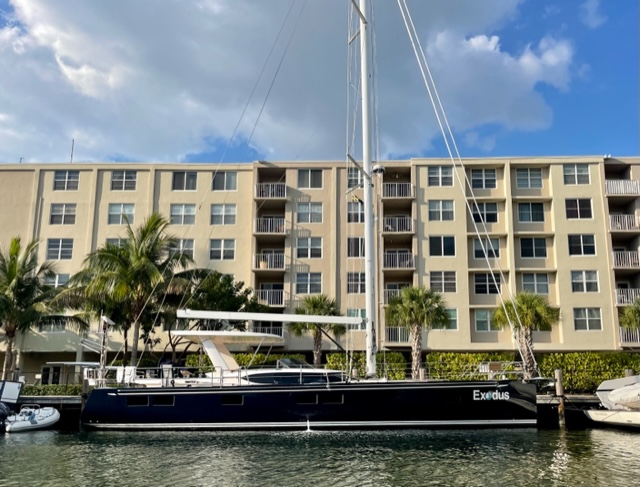
Aside from the hot, sunny days and visits with my college friend and his wife, this Bostonian does not find a lot to like about Fort Lauderdale. I can't tell one strip mall from another- which one has the Home Depot, TJ Maxx and Publix, which one has the Container Store, Best Buy and Whole Foods. The red traffic lights in town are interminably long, causing people to read a book, check their email, or take a nap, and delay moving on the green. We were warned not to beep (which for Boston drivers is like holding back horses at the start of a race) for fear some enraged driver might take out a gun and shoot us (I know, I know, but that is what we were told.)
To make matters worse, the traffic stops for trains, of which there are many, and for bridges, of which there are also many. It takes a long time to get to the highway, and when you finally do get to the highway, it is interstate 95 which is bumper to bumper, seemingly any time of day or night. If that weren't enough, 700-pound alligators come out from nowhere and eat grandmothers and pythons are invading the neighborhoods! And if THAT weren't enough, the No See'ums have found me! And Florida politics? Shoot me. Oops, I don't really mean that literally!
But like it or not, we are here for a while. The commissioning process of a new boat is long, hard and often frustrating to the new owners (us), who are impatient to get out sailing, meet their friends, and watch the sunset from the stern with a drink in hand. The boat ships without a mast or sails, so we needed all the rigging installed, and inevitably there are a myriad of problems that arise with any new boat because no one has yet lived aboard to work out the bugs. Some of the stuff I understand, but many, I haven't a clue. Apparently, the batteries are not "talking" to the inverter/charger or to the voltage regulator and there is "cross talk" along the bus (huh?), and the whole system needs updated firmware. What is firmware anyway, and when did batteries start having computers in them? It's all very complicated. And just when you think you are making progress, either more items get added, or items that you thought had been crossed off randomly stop working.
But the experts tell us that work will be finished on our timeline to leave the dock early next week, and today, it seems we are making progress. Today, the list seems to be down to a few small items. Today, it seems as if we will leave the dock shortly with everything (mostly) working. Today, we couldn't be happier with our choice of sailboat.
So, early this morning, we checked the weather, excited to finally "get out there."
According to our weather forecaster, there is a "relatively high-impact weather potential" for next week. This, I do understand, and do not like. A big front is coming in. North winds. Gusts to 40 knots. No way we are leaving the dock to cross the Gulf Stream in that.
We call all of this "boating". Doesn't it sound like fun?
A Year Ashore and a New Chapter - Fingers Crossed (By Ronna)
February 6, 2023
I have lists galore on my iPhone, on an app that my highly organized friend Shiera introduced me to, called "Anylist". On this app, I have a list for everything- from boat inventory, to medications, to birthday gift ideas, to the menu for Thanksgiving Dinners since 2019. They are all on my Anylist app, just a finger swipe away. I am more organized than I ever was, although that is certainly not saying much. I sometimes forget that I have created a list as I wander around the grocery store, the tech equivalent of leaving your grocery list on the kitchen counter.
As I was cleaning out and editing some of my old lists the other day, I came across a list I created while still living on our sailboat, named "Year Off Things to Accomplish". I created the list because I did not want to squander the opportunity of living on land while retired. Certainly, great things could be accomplished in a year, living in a city where same day Amazon package delivery is a "thing," with a washing machine and dryer steps away. With these modern conveniences, I would have lots of time to fill, and boy was I going to get things done. I planned to kick butt (literally and metaphorically), and somehow make a difference.
Reflecting on the list, it was mostly personal and doable: lose 10 pounds (although when I finally weighed myself after four years, it turned out to be more like 15), take an iPhone photo class, create a family recipe book, knit sweaters for the new grandbaby, volunteer at a place that does some good, and take a safety at sea course. I got to cross most of these off the list. But I fell short in numerous ways- by not join a writing group, by not making any progress on a children's book that I had started years ago, and by not writing. I basically continued my long hiatus from writing; I have no idea why I couldn't write; it just didn't happen. Am I ok with all of that? Not really, so here we are (it's never too late!)
In many respects, it seems like it was yesterday that I was living on the boat, creating the Anylist, afraid of the freedom of living on land rather than at sea, where just the necessities of life keep you busy all day. But now the end of my time on land is closing in on me. And now is not the time to add things to the list or feel remorseful about things not done. It is a time to anticipate and plan our next stage and anticipating (or some might say "worrying") is what both Mike and I have been doing.
Mike and I worry about whether the boat will arrive on time and undamaged. So much can go wrong at sea, and we have planned so much around her safe and timely arrival in Florida. We compulsively track UHL Focus, the cargo ship that carries our new sailboat. We tracked her as she left her birthplace in Taiwan at the beginning of January, traveled in the wrong direction to pick up more cargo in China, then headed across the Pacific. As ridiculous as it might seem, Mike and I both worried that China might take this exact opportunity to impose a sea blockade against Taiwan and stop the cargo ship from leaving the South China sea. It didn't.
We worried about bad weather and difficult seas across the Pacific, and yet the weather was benign. When the cargo ship made it across the Pacific and arrived in and then departed Ensenada, Mexico safely, we briefly breathed a sigh of relief. But just the other night the ship simply stopped her 14-knot progress toward the Panama Canal, coming to a complete stop for over six hours off the Pacific coast of Guatemala. Mike and I just about lost our minds. Was there an engine problem? Was there an accident? Was there a pirate in control of the helm declaring "I'm the Captain now!"? We have no idea. She just started moving again.
Will our stuff get there? For the fist time in our lives, we hired movers to move our boxes to Florida. We have no idea where our stuff is. Did the movers leave our boxes in a truck out of doors when the temperature outside was minus 17? Our boxes could be in South Carolina, but they also might be in Chelsea. Again, we have no control.
But mostly, I am anxious about moving back on the boat, to a life I remember loving very much, but now seems like a lifetime ago. Did I really love it that much? I have become reliant on the conveniences of land living: Trader Joe's down the street, a CVS on the next corner, boarding a plane if I want to go somewhere new, popping over to see my grandson.
Will we love her, this new Exodus, this sailing life? How long will it take to get to know this new boat like the back of my hand? Will we still have our dear friends in our sailing community? Will my grandson remember me when we are gone? The worries are piling up, as they tend to do with big transitions.
I do not sleep well.
As Carly Simon once sang, "we can never know the days to come, but we think about them anyway...Anticipation is making me late, is keepin' me waiting."
Our new adventure is imminent (I think). Stand by and stay tuned.
Don’t Talk to Me - I’m Knitting! (By Ronna)
October 24, 2022
I am sorry for being a bitch right now, but I'm knitting. I can't be bothered. As in, whatever you do right now,
DON'T BOTHER ME...please. Don't tell me where you are going, I don't care. Don't ask me a question, even if it's simple.
Do I want to walk with you to CVS? No! Do I want to go buy some food for the empty refrigerator?
NO! I don't want to go out- ever-- I just want to stay home and knit.
Please, don't sit down next to me on the couch. Don't even sit on the far end of the couch. And certainly do NOT put on the TV. Actually, can you simply stay far away any room I currently occupy as I sit and knit? Don't you have somewhere to be? I love you, but you are very distracting, and even though I know you have the right to be in the house with me, I am not sure I accept that right now.
Oh, why did I listen to them, these Women Who Knit? They said I could do it. They said I would learn new techniques. They said it would be hard, but not too hard. And I believed them.
I joined in on the fun of the autumn Westknits Mystery Shawl knit-a-thon on the day it started three weeks ago. Basically, I have done nothing else since I cast on those first i-cord stitches. We are knitting a shawl, in parts. Participants have picked their three colors, but don't know what the entire shawl will look like. A new section of the pattern is revealed every week for a month. Three sections have been revealed so far. I am halfway through the first. They say it's not a race. Good thing.
Admittedly I have gone off the deep end, and I might be there for say, oh, maybe 6 months or so (if I able to continue with my current frenzied rate of progress, which is doubtful). I want to quit, to go back to the relaxed knitter I once was, making baby sweaters and blankets. I could knit and talk, listen to a podcast, or watch TV, and I would happily rise off the couch, as long as I was allowed to "just finish this row." But now that I have started this project, I can't quit. I am on a mission to completion.
I am counting the stitches until the next slip slip knit, pass one over. I am concentrating on the slip, slip knit. I am trying to remember what row I just finished, what pattern repeat I am on. I might lose a stitch. I might split a stitch. I might skip a make one left. I live in fear of messing up and having to stop everything and spend an afternoon at the knitting store, losing precious hours while waiting impatiently for the owner to fix what I have messed up. And as all knitters know, knitting stores do not hold emergency hours.
I don't want to exercise, I don't want to clean up my breakfast dishes, I don't want to answer emails, I don't want to visit your mother. Do I even want to babysit my grandson? I take the fifth. And the worst of this is that I idiotically convinced my best friend to do the knit a thon with me. Now she hates me. I sure miss her as my best friend. But I have no time for friends anymore, so maybe it's for the best.
I might lose everything I love, but in the end, I will prevail. I will have a new shawl, replete with mistakes, in colors that I am not sure I really like. When I finish this shawl, it will be the only thing I ever wear, even if it is hideous.
Enough with this writing! I want to be knitting! I want to finish pattern repeat four thousand and seven. I am sure I could have done another row or two instead of dithering on about my misery. The typos and mistakes in grammar be damned! I may make one right, but it won't be in this essay.